I keep coming back to the same chart whenever I hear someone argue that the Federal Reserve should raise interest rates again in 2026. It shows the U.S. unemployment rate going back to 1948, with recessions shaded in gray. Looking across those decades, I find it difficult to ignore how often a seemingly manageable increase in unemployment became part of a much larger economic problem. With hiring already weak, I believe the Fed should give its September rate increase time to work before putting additional pressure on businesses and households.
The unemployment chart on Nowflation provides some perspective on that concern. In several past downturns, unemployment had risen roughly a full percentage point from its earlier low while the economy was already in recession. By the time the increase became obvious, businesses were responding to conditions that had been deteriorating for months.
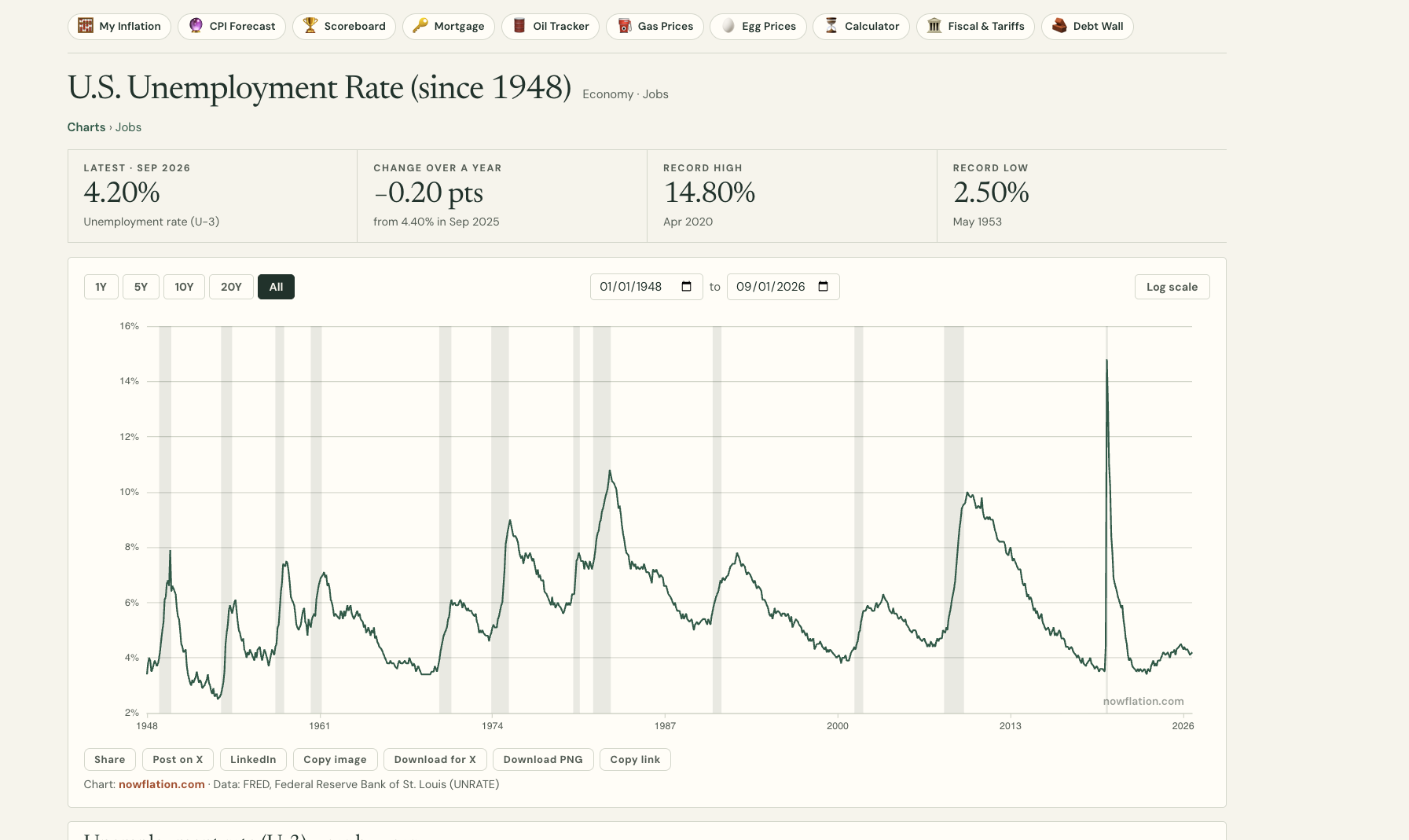
Chart: Nowflation · Data: FRED UNRATE · September 2026: 4.20%
Consider what happened in 2001. Unemployment climbed from 3.8% in April 2000 to 4.9% in August 2001, when the economy was already in a recession. A similar pattern appeared ahead of the financial crisis. In May 2007, unemployment was 4.4%. By May 2008, it had reached 5.4%, and that recession was already underway as well. Neither number, viewed alone, captured how much worse conditions would become.
I would be careful about turning those examples into a prediction that every one-percentage-point increase guarantees a recession. The chart also doesn’t establish that interest rates caused each downturn. My concern is more practical: waiting until unemployment looks terrible can mean waiting until employers have already made decisions that are difficult to reverse.
Today’s numbers deserve that same careful reading. The unemployment rate was 4.2% in September, above the 3.4% low reached in 2023 but below the 4.4% recorded a year earlier. That annual improvement is worth acknowledging. We are not looking at an uninterrupted surge in unemployment, and I don’t believe this chart alone justifies declaring that a recession is here.
What concerns me more is the pace of hiring. The economy added just 29,000 payroll jobs in September, while July and August were revised down by a combined 60,000. Over the 12 months preceding September, job growth averaged only 45,000 a month. One disappointing report can be noise. A prolonged period of modest hiring, followed by another weak month and downward revisions, makes me question how much additional pressure the labor market should be asked to absorb.
Payroll growth needs context, including how quickly the available workforce is growing. A smaller increase in the number of people seeking work can reduce the number of new jobs needed to keep unemployment stable. Even allowing for that, I struggle to look at these hiring figures and conclude that another rate increase is the right next step.
Think about the decision from a business owner’s perspective. You have been considering opening another location, and the expansion would require financing and additional employees. Then the borrowing costs come in higher than expected, while sales at your existing location fall short of your projections. The expansion may still make sense eventually, but committing to it now becomes harder to justify. You decide to wait, and the people you would have hired never receive an offer.
If sales remain weak, that caution can spread to the existing business. When an employee leaves, you hold off on replacing them. You reduce overtime and ask the remaining staff to cover more work. Layoffs may come later, after those adjustments fail to bring expenses in line with revenue. There is no single moment when every business makes these decisions, which is part of what makes the slowdown difficult to judge as it unfolds.
For workers, the consequences can arrive before they lose a job. Fewer openings make it harder to find better pay or leave a position that no longer works for their family. Reduced hours can force a household to cut spending even while everyone remains employed. If a layoff eventually happens, the mortgage, groceries and insurance still have to be paid while the search for another paycheck begins. As those households spend less, other businesses can feel the effects.
Inflation belongs in this discussion, too. People are frustrated by the cost of everyday necessities, and the Fed has a responsibility to bring inflation under control. Persistent inflation erodes what a paycheck can buy and makes saving harder. If the data show that price pressures are becoming broader or more entrenched, policymakers need to respond. I wouldn’t dismiss that risk simply because hiring is weak.
Employment is also part of the Fed’s responsibility, and September’s rate increase is still recent. The Fed raised its target range by a quarter of a percentage point, a decision whose effects will continue to work through borrowing and spending decisions over time. A business renewing a loan or reconsidering an expansion may adjust its plans months after the announcement. Another increase would add pressure before we have a clear picture of how those adjustments are developing.
My preference is to hold rates steady for the remainder of 2026 while watching the inflation reports, hiring trends and employment revisions. That judgment should remain open to new evidence. For now, I believe the weakness in hiring gives the Fed a good reason to wait.
The unemployment chart cannot tell us exactly what comes next. It does show why I am uncomfortable with the idea that policymakers should wait for a much higher unemployment rate before becoming concerned. By then, the discussion is about businesses that have already cut their payrolls and families trying to replace lost income. I would rather give the September decision time to work than risk making that situation more likely.